

Section 21 is gone. Fixed terms no longer exist. And as of 1 May 2026, every assured tenancy in England is open-ended, rolling, and subject to a new set of rules that change how you let, manage, and recover your properties.
The Renters Rights Act 2025 received Royal Assent on 27 October 2025. For a landlord with one or two properties, many of these changes are manageable with updated documents and adjusted processes. For a landlord with five or more properties, the combined effect on possession timelines, rent review administration, database compliance, and portfolio planning is significant and needs a systematic response.
This guide covers every material change in the Act, when each part takes effect, and the actions portfolio landlords need to take now, before the end of July 2026, and over the two years that follow.
1. What the Act Does
The Renters Rights Act 2025 makes five structural changes to the private rented sector in England. Each one changes how landlords let property, recover possession, and manage income across a portfolio.
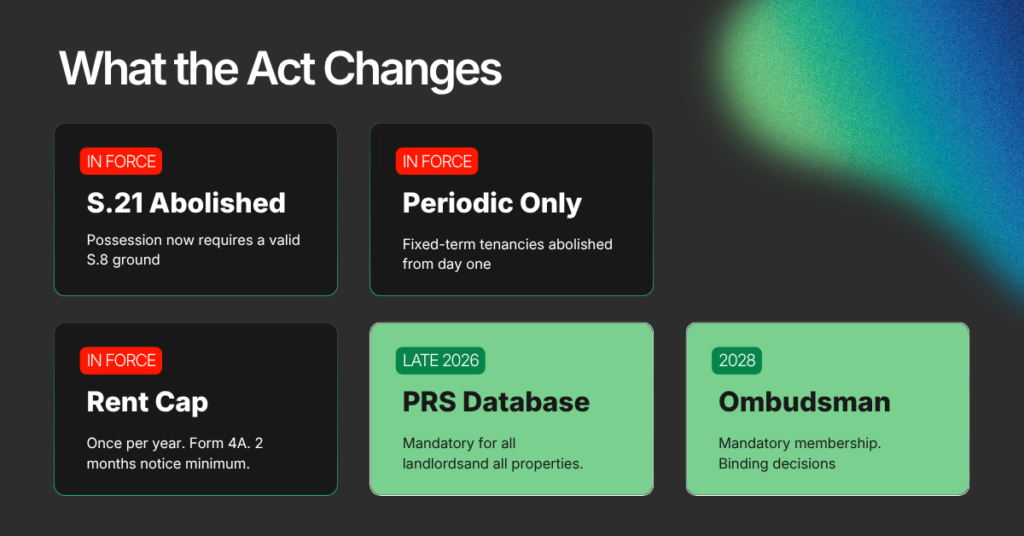
End of Section 21 (in effect 1 May 2026): No-fault evictions are abolished. Possession now requires a legal ground under Section 8 of the Housing Act 1988.
Periodic tenancies only (in effect 1 May 2026): Fixed-term assured shorthold tenancies are abolished. All tenancies are open-ended and rolling from the outset.
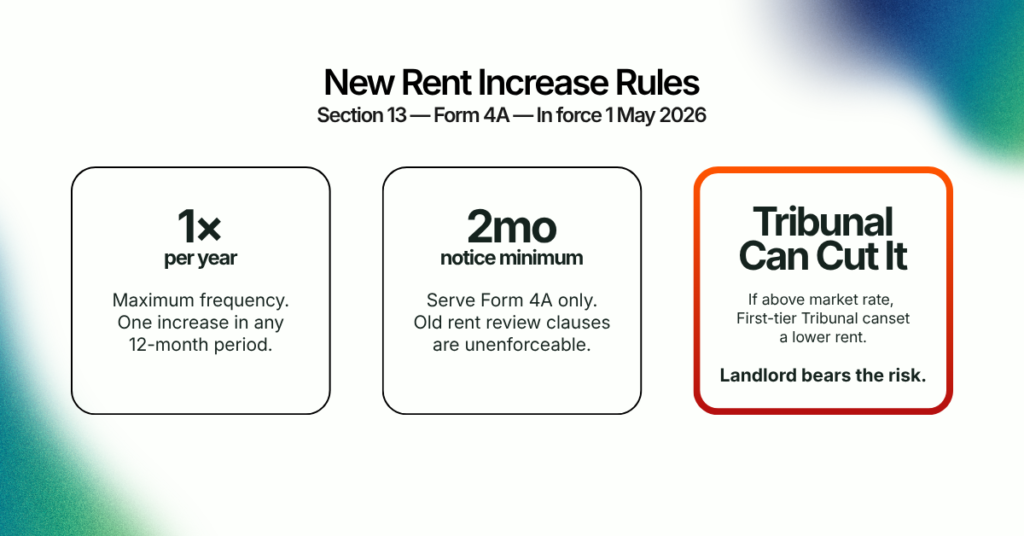
Restricted rent increases (in effect 1 May 2026): Rent can only rise once a year, via a Section 13 notice, with at least two months warning. Tenants can challenge excessive increases at the First-tier Tribunal (Property Chamber).
Private Rented Sector Database (from late 2026): Mandatory registration for all landlords and properties on a new national database. Registration is required to access most Section 8 grounds.
Private Rented Sector Ombudsman (2028): Membership is mandatory. Decisions are legally binding. Disputes can be resolved without court action.
The Act also introduces anti-discrimination rules covering tenants with children or on benefits, a statutory pet request process, a ban on rental bidding, and a forthcoming Decent Homes Standard for the private rented sector.
2. When Changes Take Effect
The Act is being implemented in three phases. The most significant reforms came into effect in phase one on 1 May 2026.
27 October 2025: Royal Assent
The Act becomes law. Most provisions are not yet in force.
27 December 2025: Phase 1a, local authority enforcement powers
Councils get new investigatory powers to inspect properties, demand documents, and access third-party data.
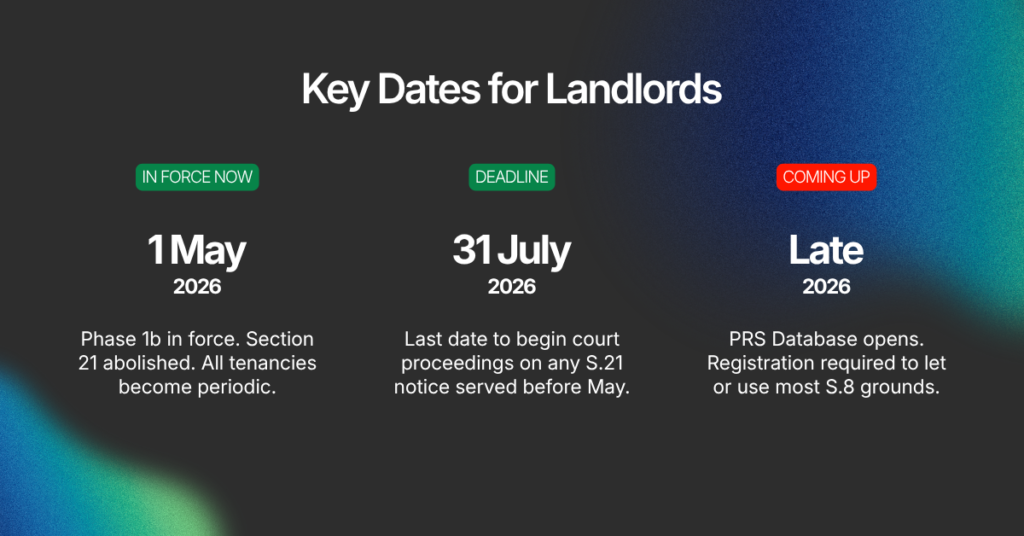
1 May 2026: Phase 1b, core tenancy reforms (in force now)
Section 21 abolished. All assured tenancies become periodic. Rent increase restrictions, pet rights, rental bidding ban, and anti-discrimination rules all apply from this date.
31 May 2026: Deadline, government Information Sheet for existing tenants
Every landlord with assured tenancies must serve the official government Information Sheet on existing tenants. Civil penalty up to £7,000 for failure.
31 July 2026: Deadline, final date for Section 21 possession claims
Any Section 21 notice served before 1 May 2026 must have court proceedings begun by 31 July 2026. After this date, those notices are invalid.
Late 2026: Phase 2a, Private Rented Sector Database (regional rollout)
Mandatory registration for all landlords and properties. Fee payable. Full national coverage in 2027.
2028: Phase 2b, Private Rented Sector Ombudsman
Membership mandatory. Binding dispute resolution. Compensation orders possible.
After 2035: Phase 3, Decent Homes Standard
The private rented sector will be required to meet property condition standards currently applied to social housing.
3. The End of Section 21
Section 21 of the Housing Act 1988 allowed landlords to recover possession without stating a reason, provided the correct notice was served and the fixed term had ended. From 1 May 2026, Section 21 no longer exists.
The last valid Section 21 notices were those served before 1 May 2026. These can still be used to apply to court, but only until 31 July 2026. After that date, any possession application must rely on a Section 8 ground.
For portfolio landlords with ongoing possession cases based on pre-May 2026 Section 21 notices: the court application deadline is 31 July 2026. After that date those notices are invalid regardless of when they were served.
The consequence for portfolio planning is that recovering a property now requires advance preparation. The grounds for selling or moving into a property require four months notice and cannot be used in the first twelve months of a tenancy. Planning possession timelines around portfolio changes, refurbishments, sales, and reconfigurations now needs to start earlier.
One practical note: courts have been slower to process possession claims since commencement. A Section 8 notice served correctly today may still take six to twelve months to reach a possession order through the court system. Any landlord who relies on possession timing to fund a sale or finance a renovation should build that delay into the plan.
4. Fixed-Term Tenancies Are Abolished
Fixed-term assured shorthold tenancies no longer exist. From 1 May 2026, all new tenancies must be assured periodic tenancies from the outset. Every existing assured shorthold tenancy automatically converted to an assured periodic tenancy on 1 May 2026.
Under an assured periodic tenancy, a tenant can leave at any time by giving two months notice, or less if the tenancy agreement specifies a shorter period. There is no minimum term a landlord can enforce.
Portfolio impact With no fixed terms, tenant turnover can happen faster and with less predictability. Void periods between tenancies are harder to forecast. Rental income projections should use more conservative occupancy assumptions than before.
Rent review clauses in existing tenancy agreements are also unenforceable from 1 May 2026. Rent can only be increased through the Section 13 process, regardless of what the tenancy agreement says.
5. How Rent Increases Work Now
Landlords can only increase rent once per year. The process is now formal and follows the Section 13 procedure, using the new Form 4A. A notice must be served with at least two months warning. The increase must reflect market rates. If the tenant challenges at tribunal, the First-tier Tribunal (Property Chamber) can set a lower rent than the landlord proposed.
The Section 13 process, step by step
Step 1: Decide the new rent:
It must reflect the current market rate for comparable properties in the area.
Step 2: ServeForm 4A with at least two months notice:
The official government form must be used. A rent review clause in a tenancy agreement is not a valid substitute.
Step 3: Wait for the notice period:
The increase takes effect on the date stated in the notice, not before.
Step 4: Tenant may challenge at tribunal:
The First-tier Tribunal (Property Chamber) can set a lower rent if the proposed increase exceeds market rate. The landlord takes that risk.
For a portfolio of ten properties, this means tracking ten separate annual review dates and serving ten formal notices. A rent review calendar is now a compliance requirement, not optional.
Landlords also cannot demand more than one month’s rent in advance after a tenancy agreement is signed. Rental bidding is banned. Properties must be advertised at a stated rent and offers above it cannot be accepted.
6. Section 8 Grounds for Possession
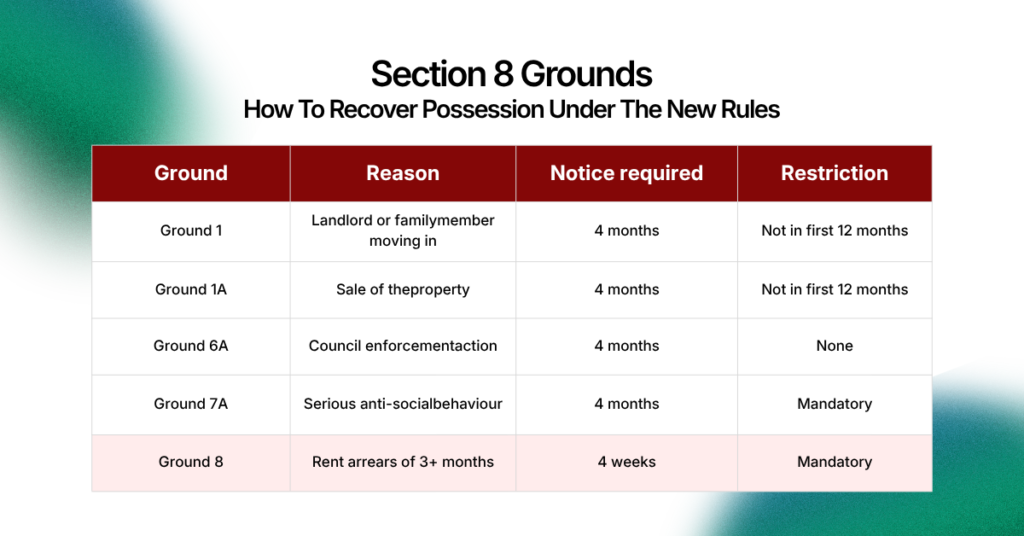
All possession must now go through Section 8 of the Housing Act 1988. Several grounds have been amended and new ones added. The most material ones for portfolio landlords are below.
Ground 1 (amended): Landlord or family member moving in Notice required: 4 months. Restriction: Cannot be used in the first 12 months of a tenancy.
Ground 1A (new): Sale of the property Notice required: 4 months. Restriction: Cannot be used in the first 12 months of a tenancy.
Ground 6A (new): Enforcement action by local authority Notice required: 4 weeks. Restriction: None.
Ground 7A (amended): Serious anti-social behaviour Notice required: 4 weeks. Restriction: None. Mandatory ground, court must grant if proved.
Ground 8 (amended): Rent arrears of at least 3 months Notice required: 4 weeks. Restriction: Mandatory ground.
Ground 14 (amended): Anti-social behaviour (discretionary) Notice required: 2 weeks. Restriction: Court has discretion.
The 12-month restriction on Grounds 1 and 1A is a significant constraint for portfolio landlords who need to sell or redeploy a property. It must be factored into acquisition decisions. If a property is tenanted at the point of purchase, the twelve months runs from the original tenancy start date, not the date of purchase.
From late 2026, registration on the Private Rented Sector Database will be required to use most Section 8 grounds. Unregistered landlords will be unable to obtain a possession order, except under Grounds 7A and 14 for anti-social behaviour.
7. Pets and Anti-Discrimination
Tenants now have a statutory right to request permission to keep a pet. A landlord cannot unreasonably refuse. Reasonable grounds for refusal include a leasehold restriction in the head lease, a property type that makes keeping a pet impractical, or a specific documented risk. The landlord must respond within 28 days.
If consent is given, a landlord can require the tenant to take out pet damage insurance. The cost sits with the tenant. The deposit cannot be increased as a condition of consent and remains capped at five weeks rent.
For portfolio landlords with leasehold flats: check head leases before responding to any pet request. If the head lease prohibits pets, refusal is likely reasonable. Refusing without checking, or refusing on vague grounds, risks a civil penalty.
The Act also prohibits landlords from refusing to let, or applying different terms, to prospective tenants because they have children or are in receipt of benefits. Any “no DSS” or “no children” restriction is now unlawful. All property listings and agency instructions need to be reviewed.
8. The Rental Bidding Ban
Every property advertised for residential letting must display a stated asking rent. Landlords and letting agents cannot accept, encourage, or solicit offers above that stated rent, even if a tenant offers more voluntarily.
For portfolio landlords using letting agents, the responsibility sits with the landlord. If an agent runs a bidding process without the landlord’s instruction, the liability still traces back to the landlord. Agency agreements and written instructions need to reflect the new rule.
The ban also covers advance rent. A landlord or agent cannot ask for more than one month’s rent in advance at the point of signing. This may change cash flow planning for higher-value properties where two or three months was previously standard practice.
9. The Private Rented Sector Database and Ombudsman
Two new compliance structures are coming in phase two. Neither applies yet, but both require preparation now.
Private Rented Sector Database (late 2026)
Registration is mandatory for all landlords and all properties. An annual fee applies. Without registration, a landlord cannot market or let a property, and courts cannot grant most possession orders. Regional rollout begins late 2026. Full national coverage in 2027. See the GOV.UK guide to the Renters Rights Act for the latest on timelines.
For a portfolio of fifteen properties, this means fifteen individual property entries plus one landlord registration. Compliance documents needed at registration include Energy Performance Certificates, gas safety certificates, electrical installation condition reports, smoke and carbon monoxide alarm records, and deposit protection certificates. Getting these in order now avoids a bottleneck when the database opens.
Private Rented Sector Ombudsman (2028)
Membership is mandatory on launch, expected in 2028. Tenants can refer complaints. Decisions are binding and can include compensation orders. A written complaints process and response protocol should be in place before launch, not after.
A civil penalty of up to £7,000 applies for marketing or letting a property without database registration. Courts cannot grant most possession orders for unregistered landlords. The risk is not just the fine. It is losing the ability to recover a property at all.
10. The Decent Homes Standard
The Decent Homes Standard is the property condition benchmark currently applied to social housing. The Renters Rights Act extends it to the private rented sector. The government’s consultation suggested the standard will not apply in full until 2035 at the earliest.
A property meets the standard if it is free from category one hazards under the Housing Health and Safety Rating System, is in a reasonable state of repair, has reasonably modern facilities, and provides a reasonable degree of thermal comfort.
Awaab’s Law, which requires landlords to address hazards such as damp and mould within set timeframes, will also extend to the private sector at a date still to be confirmed. It currently applies to social housing only.
Portfolio landlords with older stock should treat this as a long lead-time capital decision. Properties that would fail the standard on damp, thermal performance, or disrepair need a planned investment schedule now. Retrofitting ten properties on a planned basis over three years is significantly cheaper than reacting to enforcement across the same portfolio in a compressed timeframe.
11. Portfolio Landlord Action Checklist
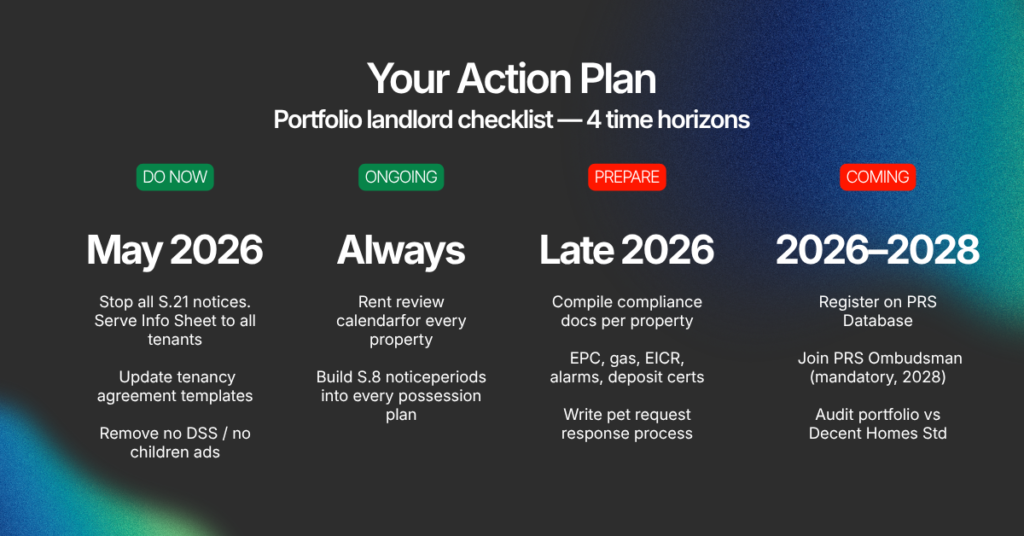
This checklist covers every material action across four time horizons.
Done: Required from 1 May 2026
- Stop all Section 21 notices. No new Section 21 notices can be served from 1 May 2026. Any notice served before this date must have court proceedings begun by 31 July 2026.
- Serve the government Information Sheet on all existing tenants. The deadline was 31 May 2026. If this has not been done, act immediately. Civil penalty up to £7,000. The official document must be downloaded from GOV.UK and served to every assured tenancy.
- Update all tenancy agreement templates. Remove fixed-term clauses, old rent review clauses, and any reference to Section 21. All new tenancies must be periodic from the outset and include a written statement of key terms before the tenancy begins.
- Remove “no DSS” and “no children” language from all advertising. This now applies to all existing and new listings. Check agency portals and any marketing materials held by letting agents.
Ongoing: Required from 1 May 2026
- Build a rent review calendar for the whole portfolio. Each tenancy has an annual review date. For ten or more properties, a spreadsheet or property management system tracking notice dates and Form 4A dispatch is a compliance tool, not a convenience.
- Put Section 8 notice periods into every possession plan. Grounds 1 and 1A require four months notice and cannot be used in the first twelve months of a tenancy. Build this into every sale, refurbishment, and redeployment timeline.
Prepare now: Database opens late 2026
- Compile compliance documents for every property. Energy Performance Certificates, gas safety certificates, electrical installation condition reports, smoke alarm records, carbon monoxide alarm records, and deposit protection certificates. One complete set per property.
- Write a pet request response process. Define the standard response for pet requests, with specific checks for leasehold restrictions in head leases.
Coming: Late 2026 and beyond
- Register on the Private Rented Sector Database. Regional rollout begins late 2026. Without registration: no marketing, no new lets, and no possession orders for most grounds.
- Join the Private Rented Sector Ombudsman. Expected launch 2028. Membership mandatory. Compensation orders are binding. A complaints protocol needs to exist before the first complaint arrives, not in response to one.
- Audit portfolio against the Decent Homes Standard. Not required until after 2035 at the earliest. But capital expenditure on older stock takes years to plan and deliver. Properties with known damp, disrepair, or poor thermal performance need a costed investment schedule now.
Frequently Asked Questions
Both. From 1 May 2026, all existing assured shorthold tenancies automatically converted to assured periodic tenancies. The new rules, including the Section 21 ban, rent increase restrictions, and pet rights, apply immediately to every assured tenancy, not just those started after the Act came into force. The GOV.UK guide to the Renters Rights Act sets out the full transitional arrangements.
No. Fixed-term assured shorthold tenancies have been abolished. All new tenancies must be periodic from the outset. Any fixed term in an existing tenancy agreement ended automatically on 1 May 2026.
You must serve a Section 13 notice using Form 4A, giving at least two months notice before the increase takes effect. The increase must reflect market rate. Tenants can challenge at the First-tier Tribunal. You can only increase rent once in any twelve-month period.
Serve a Section 8 notice citing one or more valid statutory grounds. For recovering the property to sell or move in, use Ground 1 or Ground 1A. Both require four months notice and cannot be used in the first twelve months of a tenancy. For serious rent arrears, Ground 8 is a mandatory ground requiring four weeks notice. The full schedule of grounds is set out in Schedule 2 of the Housing Act 1988, as amended by the Renters Rights Act.
A landlord cannot use Ground 1 (moving in) or Ground 1A (selling) within the first twelve months of a tenancy. For portfolio landlords who buy tenanted properties, the twelve months runs from the start of the original tenancy, not from the purchase date. This must be factored into acquisition decisions before exchange.
You cannot unreasonably refuse. Reasonable grounds for refusal include a leasehold restriction in the head lease, a property type that makes keeping a pet impractical, or a specific documented risk. You must respond within 28 days. If you consent, you can require the tenant to obtain pet damage insurance. The deposit cannot be increased as a condition of consent.
Not yet. Regional rollout begins late 2026, with full national coverage in 2027. Once open, registration will be required before a property can be marketed or let, and before most Section 8 grounds can be used. Start compiling compliance documents now.
No. The Act applies to England only. Scotland operates under the Private Housing (Tenancies) (Scotland) Act 2016. Wales operates under the Renting Homes (Wales) Act 2016. Landlords with properties in more than one nation need to apply the relevant legislation for each separately.
Published May 2026. Last reviewed May 2026. For information only and not legal advice. Verify current rules at GOV.UK. Speak with a qualified adviser for guidance on your specific circumstances.